
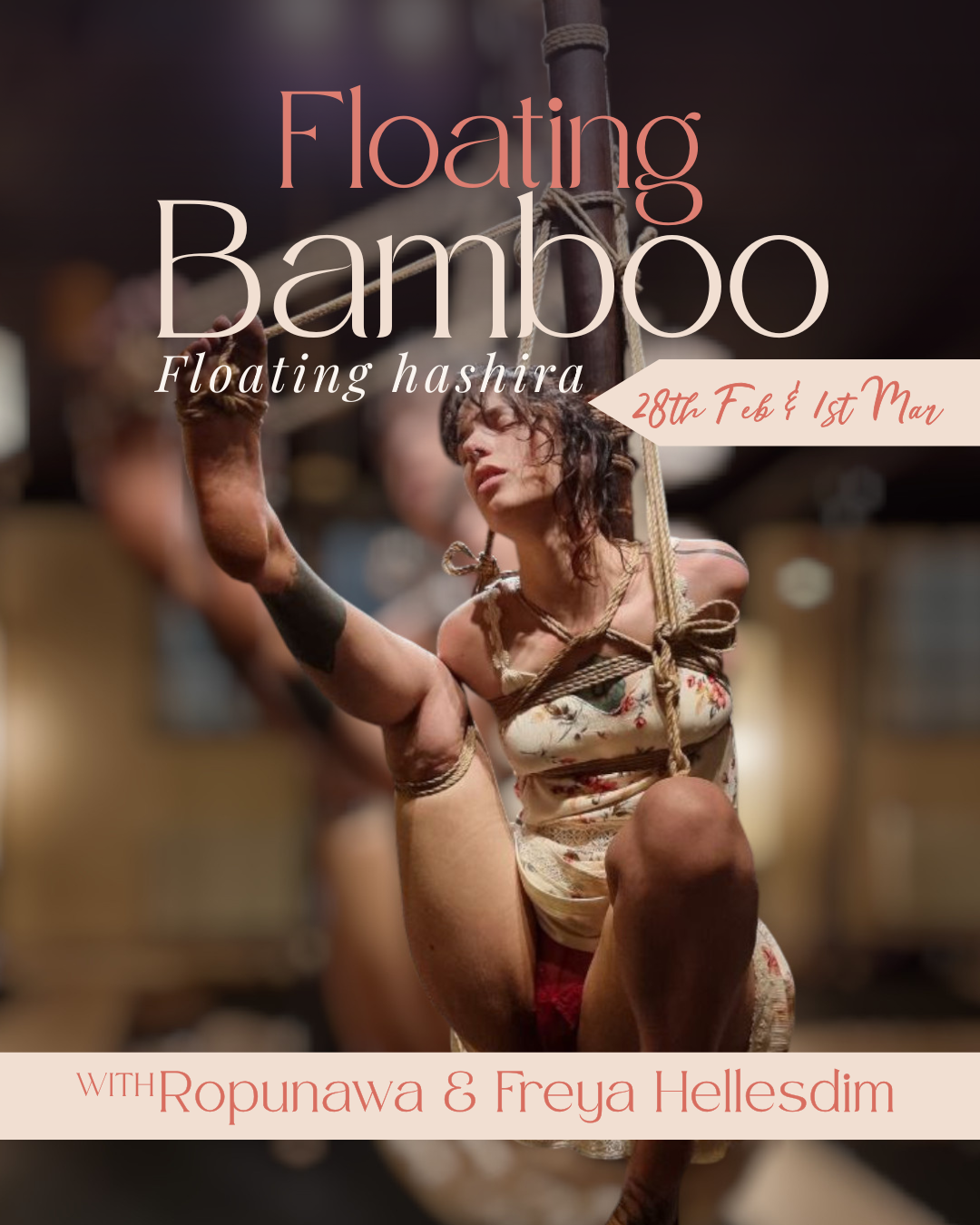
With Ropunawa & Freya Hellesdim
Floating Bamboo (floating hashira)
In this weekend workshop we will dig into the Hashira experience even without the possibility to tie on a pole.
Over the course of this workshop, you will learn how to rig bamboo safely as a vertical suspension point, including the setup of a special, solid hardpoint that allows secure tying onto a moving object. We will closely examine the specific safety considerations this environment demands: managing micro-movement, rotation, shifting load paths, and the increased mental strain that can arise when both rigger and model surrender absolute stability. A strong focus is placed on staying safe, attentive, and—whenever possible—calm and grounded throughout the process.
Although inspired by dynamic structures, this two-day workshop is intentionally dedicated to static and slow-burning suspension shapes. We take the time to build, refine, and inhabit each form, allowing participants to explore depth rather than speed. Across the weekend, we will create six distinct suspension shapes, each clearly different in structure, sensation, and intention. The emphasis lies on thoughtful construction, sustained presence, and discovering how subtle movement and stillness interact when the anchor itself is alive.
Floating Bamboo is an invitation to slow down, listen closely—to the ropes, the body, and the space in between—and to experience suspension from a perspective that is both technically demanding and quietly transformative.
-
Suspension safe TK or Tenshi.
Both rigger and model must be experienced and confident with various suspensions and body management in ropes.This workshop is aimed to upper intermediate and advanced students.
As six hours pass very fast, switching during the exercises will not be possible.
-
You should bring 10-12 pieces of rope (7-8m), various lengths needed (one 2m rope, one 4m rope).
-
RopuNawa(he/him) first encountered Shibari/Kinbaku in 2008 at a performance in Australia. This performance stayed with him on his way back to Switzerland, where he began his own journey with the rope. He formed the foundation from Osada Steve’s style, which was taught in Switzerland at that time. However, he did not stay with this one style, but was inspired by many other teachers. For RopuNawa, there is not one way to tie, but the heart of his style lies in the need of his model. These needs can be as diverse as the individuality of the people themselves, and through the diversity of his style, he can best respond to his partners needs and wants. He appreciates the non verbal connection, that he can create with each tying partner.
The aesthetics he picked up while first getting to know Naka’s style, who influenced him early on. While Naka still accompanies him today, Tifereth has inspired him on this path for the last 2 years as well.
Yoroi was another of his great first influences, who’s style gave RopuNawa’s taste for less is more space to develop. Yagami Ren also influenced him in this direction.
Today RopuNawa unites parts of all these styles in his personal rope art, which he lives and teaches in Basel to students all over the world, as he continues to travel worldwide, giving workshops and getting inspired by his old teachers and new encounters.
Freya Hellesdîm (she/her) got into rope back in 2015. Because of her fascination with communication through the body, beyond all algorithms, she was repeatedly drawn to Shibari, whereby she explored and deepened both, the intensity and the various dynamics with her partner. Furthermore, immersing herself into the art of bondage offers her an important platform for personal expression. In the midst of physical limitations, there’s an unexpected sense of freedom for her that comes with submission. Embracing the boundaries, her mind becomes an explorer, venturing into realms of imagination and self-discovery. The continuing passion has offered her the possibility to travel internationally as a model for workshops, shootings and performances since 2018.
Booking Information
Tickets for this workshop will be available at the Early Bird price until January 31st 2026.
If you are planning to come but are unable to pay right away, and wish to pay a deposit to reserve your Early Bird spot please contact us.