
Learn shibari with us
Our Curriculum
Daruma is a dedicated space for shibari in Berlin. Our classes run as a progression - you can arrive having never touched rope, and there's a clear path from there through to suspension and beyond.
This page explains how that path works: what our levels mean, how to tell which is for you, and where to start.

Our Teaching Approach
Daruma exists to provide teaching and practise opportunities for people who want to develop a really solid technical understanding of rope, and a high level of skill when they apply it. That’s hard to build alone, which is why almost everything we run is designed to help you find a rope community through our regular courses and events.
Our core programme draws on a fusion of tying styles, with a consistent focus on developing body awareness - your own and your partner's - understanding the mechanics of the body in rope, and adapting ties to fit the person you’re tying with.
Each of our regular teachers has been chosen because they have an obvious passion both for shibari as a tool for play and connection, and for the craft of rope itself.
Regular Shibari Classes at Daruma
Our regular weekly classes progress through different skill levels to take you from absolute beginner through to suspension level. We believe that practicing shibari on a regular basis is the best way to build essential rope skills, muscle memory, and safety awareness. Daruma also offers regular rope jams, and open practice evenings to help you meet new people, practice your skills together and form community.
Our Step 1, 2 and 3 courses all run in 6 week blocks on Monday and Tuesday evenings, so that the same group of students stay together for the entire course helping them to build connections with each other, and progress together. Some people may wish to repeat each Step more than once, and because our teachers rotate between different courses, you will gain different perspectives, insights and teaching styles each time. Other people may be ready to progress to the next course straight away.
The six week courses all have a set curriculum, designed by Gestalta, to make sure that they all have a coherent logic that prepares you to move onto our more advanced classes later on.
On Wednesday evenings we run a variety of sessions for intermediate level and above; these range from tutor-led open practice sessions, to structured classes on a range of different floor, suspension or hashira ties.
Understanding Our Workshop Levels
Beginner, Intermediate, Advanced?
Figuring out your level and which rope workshops are right for you isn’t always straightforward. Terms like beginner, intermediate, and advanced can be vague, and interpretations vary widely from place to place and person to person. From experience, we know that it’s easy for people to both over- and under- estimate where they sit.
To help clarify things, we’ve created our own internal levels system.
They’re designed to reflect, as best we can, the fact that learning shibari is not a linear process. Suspension is not inherently ‘more advanced’ than floorwork. Technical skills are not harder to master than ‘soft’ skills. It’s perfectly possible to be ‘advanced’ in one aspect or style of rope whilst still being a beginner in another.
Level 0 - beginner (open)Learning the basics
Workshops and classes that are broadly open to anyone with little or no shibari experience.
Additionally, our core Step 1, 2 & 3 program is part of this level, even though only Step 1 is the only part open to those with no prior experience. The courses as a whole are designed to take you from absolute beginner through to safely attaching suspension lines and performing simple partial suspensions - which give you a solid foundation for attending other workshops later on.
Level 1 - buildingNew topic - solid base
Once you have the foundations, progression becomes much less linear. Many workshops at this level introduce a new style or technique - hashira, transitions, semenawa, aibunawa. You don’t need any prior experience with that particular subject, but you do need to be comfortable with tying (in the case of riggers), or being tied in (in the case of bottoms) frequently used ties. All participants need an awareness of the most common safety issues, and experience communicating clearly with their partner.
Level 2 - beyondGoing deeper with a topic
This level assumes you have already studied the specific subject being taught.
A level 1 hashira workshop prepares you for level 2 hashira, but not for level 2 transitions or semenawa.
Workshop prerequisites
In addition to the general levels above, you’ll usually find a section called Workshop Prerequisites in each workshop description. Read this carefully, as it’s written by the instructor and includes more specific requirements relevant to that particular class.
Our core programme
Steps 1, 2 & 3
These courses are intended to take you from absolute beginner through to safely attaching suspension lines and performing simple suspensions and partial suspensions. The curriculum was designed by Gestalta, and it aims to go deep rather than broad, helping you to develop a really firm grasp of rope bondage basics. Alongside the technical skills, they cover fluid rope handling, body mechanics & awareness, communication, safety and building a session.
They are offered in two different formats:
6 week courses are a great way to get regular, structured shibari practice and build muscle memory. The closed-group format creates a supportive learning environment, allowing you to build connections with peers at a similar skill level. They run on a rotating schedule on Monday & Tuesday evenings, to make it easier for you to find a time you can attend.
For those who live outside of Berlin, we also offer these as weekend intensive courses - the same content taught over two full days. These intensives can also be a great way for people who are already familiar with rope basics to get a refresher before taking a 6 week course
Absolute Beginner
Step 1: Elements
For those who are either completely new to shibari, or have a little prior experience but are feeling a bit rusty on the basics. The course covers simple knots, frictions, patterns, harnesses, and introduces participants to important skills such as rope handling and tensioning. By the end of the course, participants should understand how to construct a short rope scene that brings together technical and playful elements.
Beginner+
Step 2: Structures
Builds on the content of the Step 1 course, deepening and expanding on what you’ve already learnt. By the end of the course, participants should have a wider range of technical elements in their rope tool kits, a deeper understanding of common safety issues, and should be able to construct basic, suspendible harnesses, along with a range of floor ties, and use them in play.
Towards Suspension
Step 3: Uplines, partials & crafting a rope session
For those who are ready to start learning (partial-)suspensions.
We strongly encourage taking this course twice. Although both courses are aimed at preparing you for suspension, the content is in no way repetitive; each course covers very different shapes/positions, harnesses, and different ideas for incorporating uplines into your play, to help you deepen your knowledge, better adapt to the needs of the person you are tying, and help you discover your own unique tying style. Each course also alternates between being taught on a ring and on a bamboo.
Next Dates: 6 Week Courses


Next Dates: Weekend Intensives

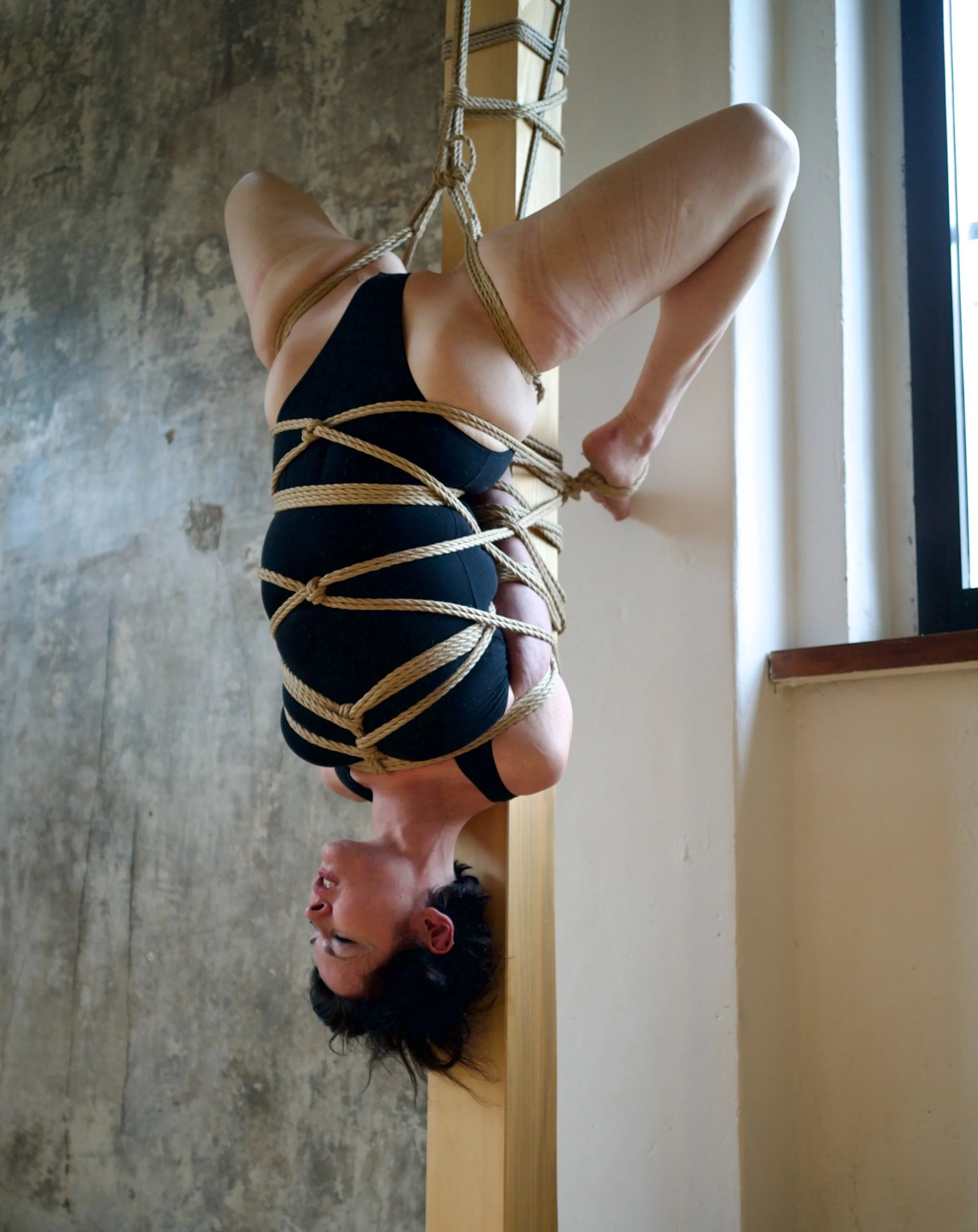
Building & Beyond
On Wednesday evenings, we offer a range of classes and open practice sessions for people who already have suspension skills (equivalent to those taught in our Step 3 course) and want to continue progressing.
Study Groups
These sessions take a deep dive into specific topics: from technical aspects of suspensions and more advanced shapes, to how to connect while tying and build better rope sessions for everyone involved. Content will vary between Level 1 and Level 2 equivalent, but all skill levels are welcome. Newer participants are invited to work at their own pace within the session’s theme, while more experienced participants may use the material as inspiration to explore and experiment.
Open Practice Evenings
Open practice evenings give you the chance to refine your skills and build on your existing knowledge in a safe, creative environment. There’s no formal demonstration, but teachers will be available to offer personalised guidance, answer questions, and suggest variations.
When? Wednesdays at 7.30pm